BHT
Butylated hydroxytoluene
No meaningful concern for most people; irritation is possible but rare.
Also written as: Butylated Hydroxytoluene · 2,6-Di-tert-butyl-p-cresol · 2,6-Di-tert-butyl-4-methylphenol
What it is
BHT is the INCI name of butylated hydroxytoluene, 2,6-di-tert-butyl-4-methylphenol, a synthetic antioxidant used in food, medicines, plastics and rubber as well as cosmetics. In a mask it limits free-radical damage, so the product keeps its smell, colour and texture once it has been exposed to air. The SCCS records cosmetic use at 0.0002 to 0.8%, and notes that some can reach a product by migrating from its packaging. It is a close chemical relative of BHA, butylated hydroxyanisole.
How it shows up on a label
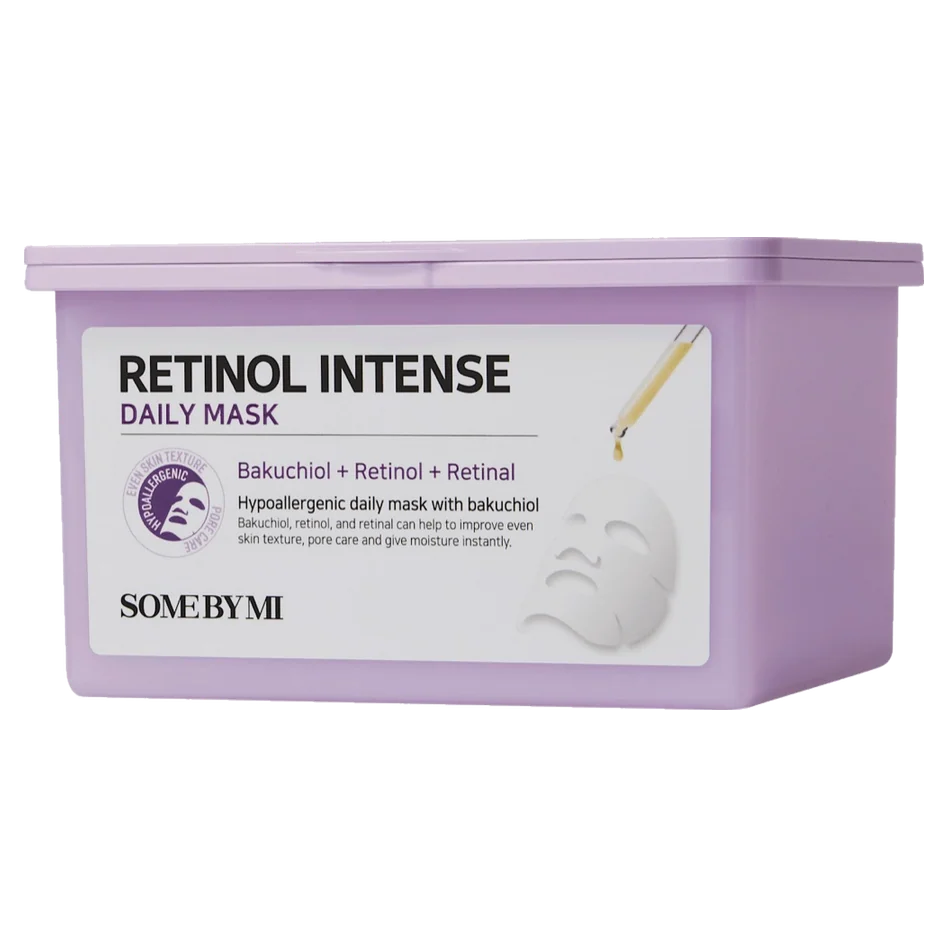
Printed on one mask here, SOME BY MI's Daily Retinol Intense, at 52nd of 62, straight after BHA and far below the point where ingredient order stops indicating quantity.
What it does well
Keeps the formula from spoiling once exposed to air
A benefit to the product, not to the skin. The SCCS describes BHT as reducing free-radical damage and spoilage, which helps a product keep its odour, colour and texture.
Moderate evidence
Worth knowing
Capped by the EU after an endocrine review that found no clear indication of endocrine-disrupting properties
The SCCS assessed BHT because of concern about possible endocrine-disrupting properties. Its 2021 opinion found that neither the computer-modelled nor the laboratory data gave any indication of them; in animals given high oral doses the main target was the liver, and the thyroid changes seen were probably a consequence of that. It judged BHT safe up to 0.8% in leave-on and rinse-off products, 0.1% in toothpaste and 0.001% in mouthwash, and the EU wrote those figures into Annex III in 2022.
Mildly irritating in animal tests
The SCCS agrees that BHT is slightly irritating to rabbit skin and eyes, and regards the risk of skin sensitisation at current use levels as negligible.
Where the EU stands
Concentration-restricted
Annex III entry 325 restricts BHT to 0.8% in leave-on and rinse-off products other than mouthwash and toothpaste, which covers every face mask, and to 0.1% in toothpaste and 0.001% in mouthwash. The entry was added by Commission Regulation (EU) 2022/2195. Non-compliant products could not be placed on the EU market from 1 July 2023, and since 1 January 2024 they may not be sold at all.
Regulation (EC) No 1223/2009, Annex III entry 325 (added by Commission Regulation (EU) 2022/2195) · source ↗
Sources (3)
Every link goes to the original: a journal, a PubMed record or an EU document.
- [1]Opinion on Butylated Hydroxytoluene (BHT), SCCS/1636/21
SCCS (Scientific Committee on Consumer Safety), European Commission · 2021
Adopted by written procedure on 2 December 2021. "BHT is safe as an ingredient up to a maximum concentration of 0.001% in mouthwash and 0.1% in toothpaste" and "up to a maximum concentration of 0.8% in other leave-on and rinse-off products", also in combined use. "Neither the in silico nor in vitro data give indication of endocrine disrupting properties of BHT"; the liver is the primary target via the oral route and "the thyroid effects observed are likely a consequence of hepatic enzyme induction". BHT "is slightly irritating based on studies on skin and eyes of rabbits", and "the risk of skin sensitisation from current use levels is negligible". The margin-of-safety calculation uses a NOAEL of 25 mg/kg bw/day derived from a two-generation reproduction study in rats (Olsen et al. 1986). Cosmetic use is reported at 0.0002 to 0.8%, and "the presence of BHT in cosmetics may also be due to migration from packaging materials". Checked 8 October 2026.
- [2]Regulation (EC) No 1223/2009 on cosmetic products, consolidated text of 18 May 2026
Official Journal of the European Union · 2026
Annex III entry 325: "2,6-Di-tert-butyl-p-cresol; 2,6-Di-tert-butyl-4-methylphenol", INCI BHT, CAS 128-37-0, EC 204-881-4; "a) Mouthwash b) Toothpaste c) Other leave-on and rinse-off products" at "a) 0,001 % b) 0,1 % c) 0,8 %", inserted by Commission Regulation (EU) 2022/2195 (corrected by corrigendum of 6 November 2025). Footnote 34: from 1 July 2023 non-compliant products "shall not be placed on the Union market", and from 1 January 2024 they "shall not be made available on the Union market". Read from the Publications Office copy of the same consolidation because EUR-Lex was not serving. Checked 8 October 2026.
- [3]CosIng entry: BHT
European Commission, CosIng database
INCI name BHT, chemical name 2,6-di-tert-butyl-p-cresol, CAS 128-37-0, EC 204-881-4. Functions: antioxidant; fragrance. Cosmetic restriction: III/325. Checked 8 October 2026.