The Latin is the law, not the marketing
The usual complaint about an ingredient list is that it is deliberately impenetrable. It is impenetrable, but the brand mostly did not choose that. Article 19 of the EU Cosmetics Regulation requires every ingredient to be printed under the common ingredient name set out in the glossary kept under Article 33 of the same regulation. That glossary is a real document with more than five thousand entries, built on the International Nomenclature of Cosmetic Ingredients, and for anything that grew in the ground the entry is a Latin binomial: ABIES ALBA LEAF OIL, ACHILLEA MILLEFOLIUM EXTRACT.
So the front of the box and the back of the box are written in two different languages by design. The front may say what it likes, within the claims rules. The back must say Houttuynia Cordata Extract, because that is the name in the glossary, and “heartleaf” is not.
Nothing stops a brand from adding the English in brackets. The glossary name has to be there; a translation alongside it is allowed and costs a few millimetres of print. Almost nobody bothers.
- of 6,073 printed entries give a second, readable name
- 7%of 6,073 printed entries give a second, readable namee.g. Butyrospermum Parkii (Shea) Butter
- of the 277 botanical entries do
- 17%of the 277 botanical entries dofive in six plants are Latin only
- ingredients we document are printed under more than one name
- 59 of 322ingredients we document are printed under more than one nameacross masks on the same shelf
One ingredient, 14 spellings
Start with the ingredient every mask contains. Across 219 masks, the entry for water is printed 14 materially different ways, not counting capitalisation, which varies too. Aqua on 97 packs, Water on 54, Aqua (Water), Aqua / Water / Eau, Water(Aqua), Purified Water. All the same ingredient, all lawful, and a shopper comparing two labels letter by letter has no way to know that.
It is not only water. Of the 322 ingredients this site documents and can match to a printed entry, 59 appear under two or more different names depending on the pack. The pattern that matters is the optional translation, because it is the one that decides whether you can read the label at all:
| Ingredient | Printed as | And also as |
|---|---|---|
| Shea butter | Butyrospermum Parkii Butter | Butyrospermum Parkii (Shea) Butter |
| Sunflower oil | Helianthus Annuus Seed Oil | Helianthus Annuus (Sunflower) Seed Oil |
| Licorice root | Dipotassium Glycyrrhizate | Glycyrrhiza Glabra (Licorice) Root Extract |
| Centella | Centella Asiatica Extract | Asiaticoside, Madecassoside, Asiatic Acid |
The last row is the harder version. Those three names are not translations of centella; they are the compounds a centella extract is standardised for, declared separately. A reader hunting for the word on a cica mask can find nothing that looks like it and still be holding three centella-derived ingredients.
The front names a family, the back names a molecule
77 of the 219 masks here put an ingredient into their own product name. That word is a promise a shopper can, in principle, check against the list. In practice the check fails for a reason that has nothing to do with Latin: the front of the box names a substance in general, and the glossary names one specific molecule.
6 masks here are named after vitamin C. Between them they declare 4 different ingredients, and only one of the 6 prints Ascorbic Acid, the molecule vitamin C actually is, and it sits in last place, entry 33 of 33, on TONYMOLY Master Lab Sheet Mask Vitamin C.
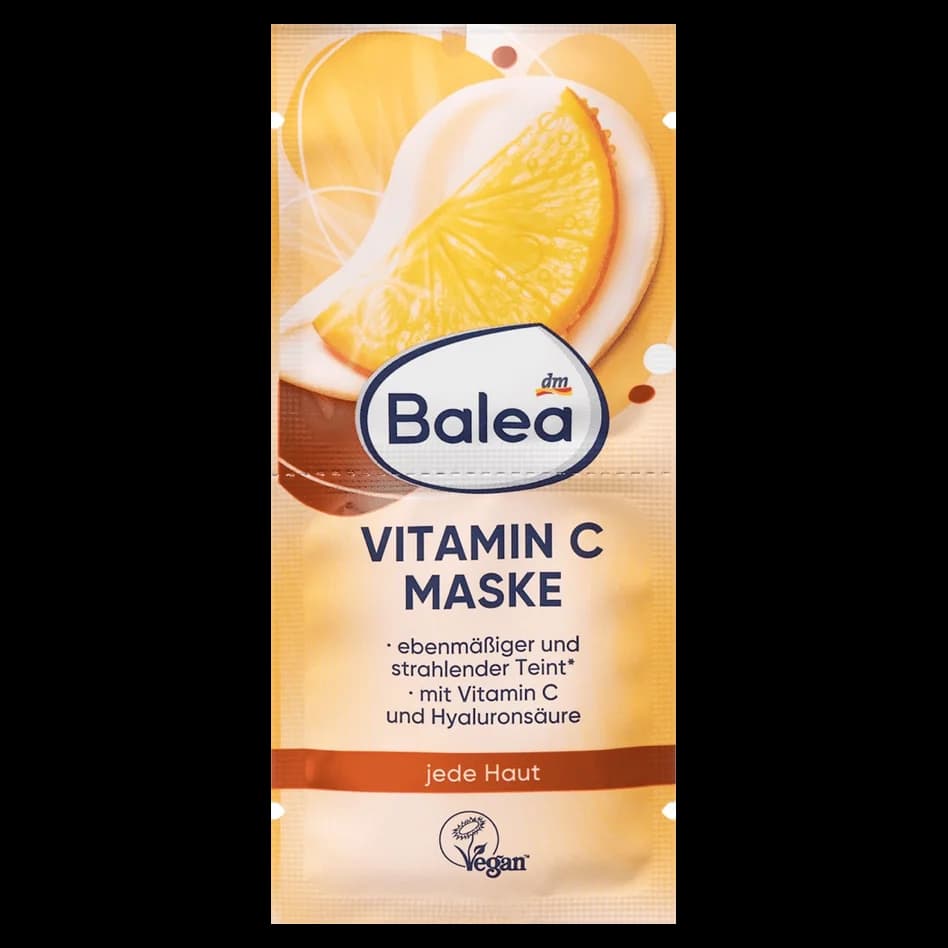
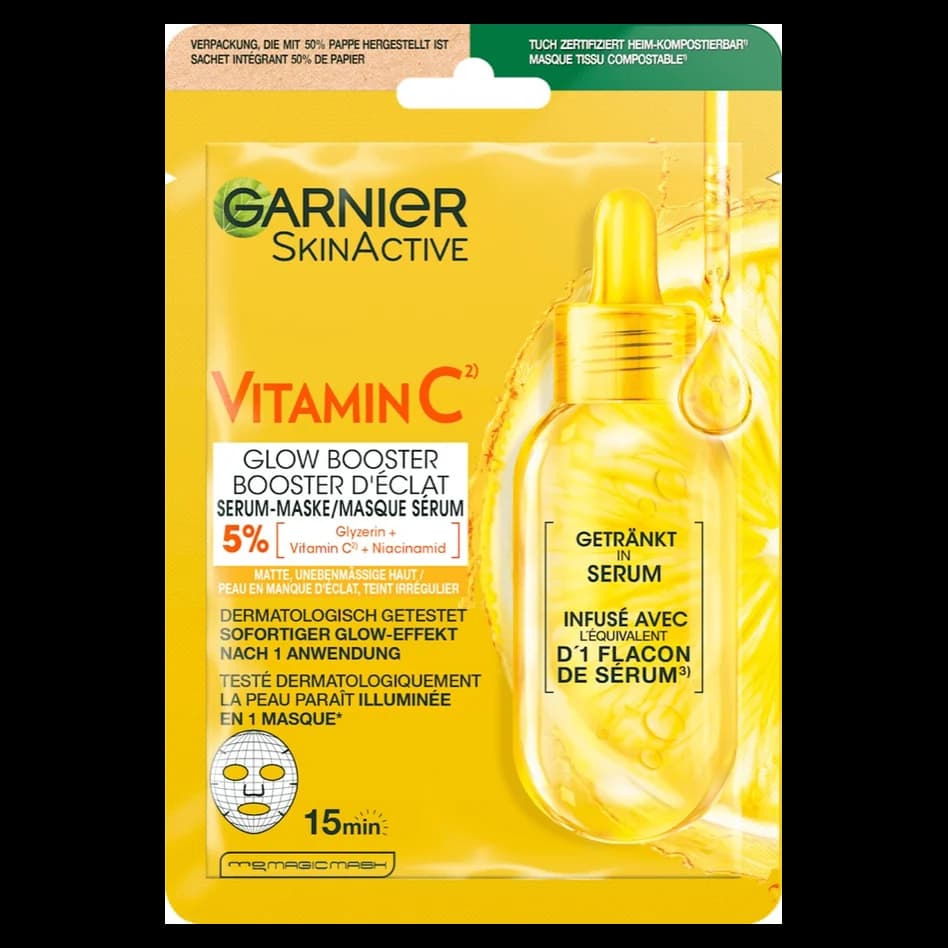
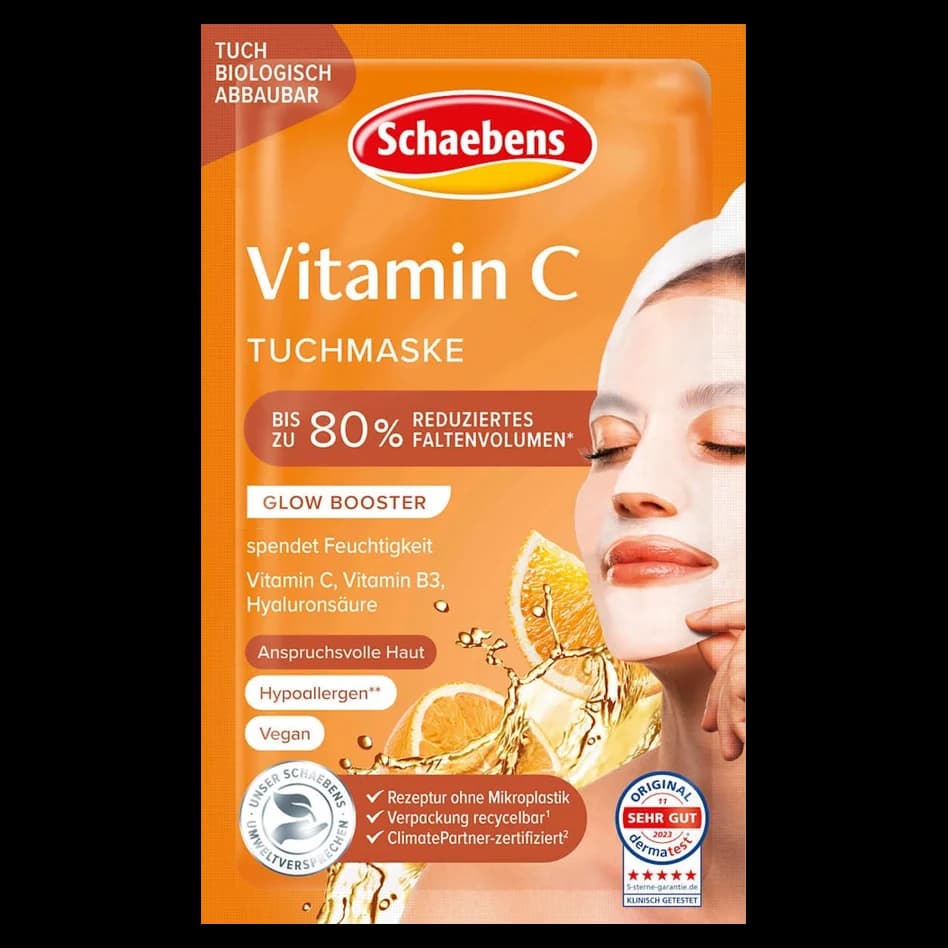
None of that is a trick. Ascorbic acid is famously unstable in water, so formulators reach for derivatives, and a derivative is a genuinely different ingredient with its own glossary entry, which is precisely why the label may not call it “vitamin C”. The consequence is narrower than a scandal and more useful: the front tells you which family was chosen, only the back tells you which member, and those are different questions.
The regulation makes the same distinction, in reverse
Retinol is the clearest case, because here the EU has done the arithmetic out loud. 6 masks here are named after retinol; the entries they actually print are Retinyl Palmitate, Retinyl Acetate and, once, Retinol (10 ppb). Since 2024, Retinol, Retinyl Palmitate and retinyl acetate share a single Annex III entry with one ceiling: 0.3% for a rinse-off or leave-on product, counted as Retinol Equivalent, the three added together and converted to the retinol they amount to.
Of the 13 front-of-box words we tested, 6 are printed on the back, at least sometimes, under a name that contains no trace of the word itself. This is the translation table the box does not print:
| On the front | On the back | Masks |
|---|---|---|
| Vitamin C | Ascorbyl Glucoside, Sodium Ascorbyl Phosphate, 3-O-Ethyl Ascorbic Acid, … | 6 |
| Retinol | Retinyl Palmitate, Retinyl Acetate, Retinol (17 Ppm), … | 6 |
| Vitamin E | Tocopheryl Acetate | 2 |
| Green tea | Camellia Sinensis Leaf Extract, Camellia Sinensis Seed Extract | 3 |
| Heartleaf | Houttuynia Cordata Extract, Houttuynia Cordata Flower/Leaf/Stem Water | 3 |
| Mugwort | Artemisia Princeps Extract, Artemisia Princeps Leaf Powder | 3 |
19 entries print their own dose
Nothing in the regulation asks a brand to print how much of an ingredient is in the pack. Concentrations live in the product information file held by the responsible person; the label gets an order, not a recipe. Which is what makes the exceptions worth reading: across 6,073 printed entries, 19 carry a number the brand volunteered.
They run further than you would expect in both directions. The largest is Centella Asiatica Extract (51%) on SKIN1004 Madagascar Centella Watergel Sheet Ampoule Mask, first on its list: a brand using the number as the claim. The smallest is on a mask named after the ingredient in question:
Sodium Acetylated Hyaluronate, Glyceryl Polymethacrylate, Retinol (10 ppb), Retinal, Madecassoside
Source: dm-drogerie markt DE, ingredient list. Full decoded list on the product page.
Ten parts per billion is 0.000001%, three hundred thousand times below the ceiling the EU sets for retinol in a product like this. Whether the intended figure was parts per billion or parts per million, the label is the only document a shopper can read, and this is what it says.
Read the entry beside it, though, and the asymmetry is the lesson. The neighbouring name is Retinal, retinaldehyde, a different and more active vitamin A form, printed with no number at all. The one figure this pack volunteers is for the ingredient in its own title; the one that may be doing the work arrives undeclared, like every other entry on every other list.
The same brand’s AHA-BHA-PHA mask does it three times over: Citric Acid(1 Ppm), Salicylic Acid(1 Ppm), Lactobionic Acid(1 Ppm) : the three acids the product is named for, each at one part per million.
Three names with nothing behind them
Across the 77 masks that name an ingredient, almost all of them declare something from the family they invoke, somewhere on the list. Three do not, and the clearest of the three is instructive because the same brand gets it right on the next product along.
Abib Collagen Gel Mask Heartleaf Jelly is sold as a heartleaf mask. Heartleaf is Houttuynia Cordata Extract, and no form of it appears in the 43 entries the pack prints. What the list does contain is collagen extract, second from last, and rose of Jericho. Meanwhile Abib Gummy Sheet Mask Heartleaf Sticker, same brand and same word on the front, declares Houttuynia Cordata Extract at position 5 of 29, high on the list, where a hero ingredient would be expected to sit.
Under the EU claims criteria this is the one situation with a bright line: if a product claims to contain a specific ingredient, that ingredient shall be deliberately present, and a claim that borrows an ingredient’s properties has to be supported, “such as by demonstrating the presence of the ingredient at an effective concentration”. A name is a claim. An ingredient list that does not contain it cannot support one.
Reading across the gap
None of this needs chemistry. It needs about eight pairs of words, after which most front-of-box claims become checkable in the shop:
- Vitamin C is ascorbic acid; on the back expect Sodium Ascorbyl Phosphate, ascorbyl glucoside or 3-O-ethyl ascorbic acid.
- Retinol and pro-retinol are Retinyl Palmitateor retinyl acetate, counted against retinol’s limit as retinol equivalent.
- Vitamin E is Tocopherol or Tocopheryl Acetate.
- Collagen is Collagen Extract, Hydrolyzed Collagen or soluble collagen.
- Hyaluronic acid is usually Sodium Hyaluronate, its salt.
- Green tea is Camellia Sinensis (Green Tea) Leaf Extract, and check the plant part, because a seed extract is not the leaf.
- Heartleaf is Houttuynia Cordata Extract; mugwort is artemisia; cica is Centella Asiatica Extract and its asiaticosides.
Then two habits. Look for the ingredient the front names and note where it sits rather than only whether it is there; the ≈1% line is what turns a position into a rough dose. And when a pack prints a number, believe the number. Every decoded panel on this site does both jobs at once, carrying the entry as printed beside the encyclopaedia entry it matches, and saying so plainly where there is no entry yet.
In short
- 01The Latin is required by law: Article 19(1)(g) makes a pack use the glossary name, and for plants the glossary name is a Latin binomial.
- 02Translating it into English alongside is allowed and optional. Only 7% of printed entries do it, and 17% of botanical ones.
- 03The front of the box names a family, the back names a molecule: 6 vitamin C masks here declare 4 different ingredients.
- 0419 entries volunteer a concentration, from 51% down to ten parts per billion.
- 05A name is a claim, and EU criteria require the named ingredient to be deliberately present. On these lists that fails outright three times.
Sources (4)
Every link goes to the original document. Figures about the masks themselves are counted from this site’s own dataset at build time.
- [1]Regulation (EC) No 1223/2009 on cosmetic products, Article 19(1)(g) and Article 33
EUR-Lex, European Union · 2009
Article 19(1)(g): all ingredients “shall be expressed by using the common ingredient name set out in the glossary provided for in Article 33. In the absence of a common ingredient name, a term as contained in a generally accepted nomenclature shall be used.” Article 33 is the glossary itself.
- [2]Commission Decision (EU) 2019/701 establishing a glossary of common ingredient names for use in the labelling of cosmetic products
EUR-Lex, European Union · 2019
The glossary required by Article 33, over 5,000 entries, built on the International Nomenclature of Cosmetic Ingredients. Plant ingredients are listed as Latin binomials: ABIES ALBA LEAF OIL, ACHILLEA MILLEFOLIUM EXTRACT. That is why the back of the box reads as it does.
- [3]Commission Regulation (EU) No 655/2013 laying down common criteria for the justification of claims used in relation to cosmetic products
EUR-Lex, European Union · 2013
Annex, Truthfulness: “If it is claimed on the product that it contains a specific ingredient, the ingredient shall be deliberately present.” And under Evidential support: a claim extrapolating an ingredient's properties to the finished product must be supported, “such as by demonstrating the presence of the ingredient at an effective concentration”.
- [4]Commission Regulation (EU) 2024/996 amending Regulation (EC) No 1223/2009 as regards vitamin A, alpha-arbutin and arbutin
EUR-Lex, European Union · 2024
Retinol, Retinyl Acetate and Retinyl Palmitate share one Annex III entry, capped at 0.05% Retinol Equivalent in body lotion and 0.3% RE in other leave-on and rinse-off products, with the label warning “Contains Vitamin A. Consider your daily intake before use”. Non-compliant products could not be placed on the EU market from 1 November 2025.